

India – China Nuclear Relations: Highlighting the Instabilities

Image source: Rediff

China and India share tense relations which mainly stem from longstanding unresolved border demarcations. Both the countries have differing perceptions over 3488 km of the Line of Actual Control (LAC). Further, China lays claims over 80,000 sq km of the Indian state of Arunachal Pradesh. As a result, two countries went to war in 1962, and continue to engage in low-level border confrontations. Despite many rounds of negotiations between special representatives of both sides, the territorial issues remain unresolved.

In terms of nuclear capabilities, China does not publicly identify India as a threat to its national security; although it covertly feels challenged by India’s nuclear weapons, particularly its indigenously developed nuclear enabled long-range Agni-series missiles that have a range over 5,000 kms that is capable to reach any part of China. 4 India’s nuclear weapons offer New Delhi a strategic parity vis-a-vis China, which allows the former to deter large scale confrontations. It has been evident in the timely de-escalation of the border confrontations as well as the in the absence of the nuclear rhetoric in their relations which, incidentally, remains common in other nuclear dyads such as the China- U.S. and India-Pakistan.

John W. Lewis and Xu Litai in China Builds the Bomb posit that the Chinese leadership’s perception of challenges is not necessarily based on situations that pose a direct threat to its security, it could often be situations that can be potentially detrimental to its security interest. In the case of South Asia, China began to recon India as a security challenge when the latter made a decisive victory against Pakistan in the 1971 war, which resulted in the liberation of East Pakistan, now known as Bangladesh. The war had demonstrated tremendous improvements in India’s conventional capabilities, as compared to its performance in the 1962 China-India war. In the immediate aftermath of the India-Pakistan war of 1971, China began to aid Pakistan in developing its nuclear capabilities, whereby it sought to complicate India’s security environment. Siddharth Ramana suggests that by proliferating to Pakistan “China can make use of its proxy in instigating a nuclear conflict in South Asia, wherein the affected parties would be Pakistan and India, with China attempting to emerge unscathed”. He refers to the Chinese aversion to Pakistani Foreign Minister’s requests to guarantee nuclear protection 1998 to suggest that China finds Pakistan as an extended deterrence proxy more practical than a recipient of its nuclear umbrella.5

In the last decade and a half, China’s threat perceptions have been elevated due to India’s strengthened strategic relations with the U.S., which took momentum with the signing of Indo-U.S. nuclear deal in 2008. It has been further been reinforced with the formation of the informal Quadrilateral Security Dialogue, known as the Quad, consisting of China’s adversarial states, namely Australia, Japan, India, and the U.S.. China has sought to respond to these developments by fortifying its relations with Islamabad by launching several infrastructural projects throughout Pakistan that have military implications for India.

China-India rivalry largely stems from longstanding disputes over the Indo-China border that led the two countries go to war in 1962. The period following the war was marked by a breach, but the relations began to improve mid-1980s onwards. Several border management agreements crafted during this period, such as the 1993 agreement on ‘Maintenance of Peace and Tranquility along the LAC in the India-China Border Areas’ enabled a relative calm in the relations; notwithstanding, the border peace was occasionally interrupted by minor border skirmishes.

In recent times, the tensions between India and China tend to routinely get intensified as they get involved frequent high-level border confrontations. Two of such confrontations took place in Chumar and the Doklam in 2014 and 2017 respectively and involved military standoff that lasted several weeks. The Galwan Valley military clashes in 2020 resulted in heavy mobilisation and unprecedented killing of several soldiers on both sides. These clashes have caused the breakdown of the various border management mechanisms that held peace at the LAC for several decades.

Monika Chansoria notes “Beijing appears intent at keeping the border dispute alive as a tactical pressure point against India. China seems to be awaiting an opportune moment in which the existing military asymmetry with India will widen and Beijing will be positioned to bring the dispute to a close on its own terms.”

China’s first nuclear tests in Lop Nur in 1964 which came close on the heels of the China – India War of 1962 elevated India’s threat perceptions. New Delhi initially took to a diplomatic recourse to achieve universal nuclear disarmament to stabilise its security environment. In 1965, India along with other states moved resolution 2028 in the UN General Assembly that sought to halt the spread of nuclear weapons. Through the negotiations, New Delhi was expecting reciprocatory obligations whereby the states who possessed nuclear weapons would halt further proliferation in return for the non-nuclear weapons states stopping acquiring them.10 In past, India was actively involved in the draft negotiations of the Nuclear Non-Proliferation Treaty (NPT) and had also voted in favour of the Irish Resolution introduced the United Nations General Assembly in 1960 to prevent nuclear proliferation.11 However, Russia, the US and the UK converted the NPT to allow unlimited nuclear proliferation to the nuclear weapons states and impose a total ban on the acquisition of nuclear weapons by all other nations. This had led India to backed out of the negotiations. Incidentally, China had not acceded to the NPT at this time. 12

India’s threat perceptions were once again raised when it received nuclear blackmail by the U.S. during the India-Pakistan war of 1971. The U.S. at that time was backing Pakistan, and had moved the nuclear enabled USS Enterprise into the Bay of Bengal to threaten India of a nuclear attack. China was also siding with Pakistan and the U.S. during this time. 13 Following the end of the war, reports of Pakistan’s efforts to acquire nuclear weapons started to emerge, and soon thereafter, evidence of China’s collaboration in Pakistan’s nuclear weapons also surfaced.14 As this stage, pressure began to be built on the Indian leadership to develop its nuclear deterrence.

Notably, as mentioned earlier, despite deep seated hostilities the nuclear component does not seep into their security relations. Several analysts suggest that the appearance of stability within the China-India nuclear dyad comes from similarities in their nuclear postures. Vipin Narang notes “China and India have both adopted assured retaliation postures. Each relies on a small but secure and survivable nuclear force, arrayed for an assured retaliatory strike against their primary opponents’ strategic targets. Both have paired a declaratory no-first-use policy with operational procedures that make the first use of nuclear weapons unlikely. Nevertheless, both assure nuclear retaliation should they sustain a nuclear hit or, adversaries must assume if a level of unacceptable conventional damage were sustained”.15

Similarly, Rajesh Basrur and Kartik Bommakanti have listed several similarities in the nuclear postures of China and India.16 These include, first, the adoption of the policy of minimum deterrence whereby both the countries prefer a relatively small number of warheads and delivery platforms; second, the fact that neither side is interested in nuclear warfighting, and hence have no proclivity for keeping nuclear weapons ready for combat; third, both the countries have a non-offensive posture of non-deployed weapons for reducing the potential for rapid spiralling of risk during tense times; fourth, they have their doctrines and force postures crafted around the concept of No First Use (NFU); fifth, both have used nuclear weapons as instruments for coercion; and, finally, both the sides have choses to conduct a small number of nuclear tests, which remain far less than other major nuclear powers.

In differing perspective, Chinese scholars often argue that India’s limited nuclear capability along with its defensive posture, and the lack of intention to go to war negates any possibility to consider India as a threat. China, till date, dismisses both India and Pakistan as legitimate nuclear weapons states as neither has signed the Treaty on the NPT. China also rebuts India’s rationale for developing nuclear weapons – which is to deter a nuclear war with China. Instead, Chinese strategic scholars argue that India developed nuclear weapons to achieve prestige and status. 17

In contrast, the rest of the section would argue that it is neither the similarities in the nuclear posture and policies that provide stability in the relations. Nor it is India’s limited nuclear capabilities that have led China to underrate India’s nuclear deterrence. As argued earlier, China faces security challenge from India, that stems from India’s conventional and nuclear capabilities, as well as from New Delhi’s strengthened relations with Beijing’s adversaries. As a result, China has crafted its nuclear strategies to counter India’s challenge. Several of such strategies have a destabilising effect on the regional security.

First, China does not identify India as a legitimate nuclear weapons state as it is not a signatory to the NPT. Such a stance by China prevents any prospects of nuclear dialogues between the two states. Adversarial nuclear weapons states, including the U.S. and Russia have been part of several bi-lateral and multilateral agreements which are designed to prevent or reduce the occurrence of ambiguities, doubts and suspicions. A lack of thereof between China and India fuels mistrust that often creates instability within the dyad.

Secondly, stemming from China’s non-acceptance of India and Pakistan as a nuclear weapon state, is its ambiguity related to its policy of NFU. China dropped the word ‘unconditional’ from its nuclear posture in 1995 and added conditionality to its NFU policy thereby making it applicable only to the NPT member states or a nuclear-weapon free zone. In 2010, China reiterated that it continues to be ‘adhered to the policy of no-first-use of nuclear weapons at any time and in any circumstances, and made the unequivocal commitment that under no circumstances will it use or threaten to use nuclear weapons against non-nuclear weapon states or nuclear-weapon-free zones.” This was a sharp reversal from the position it had stated in a letter delivered to the UN Secretary General in 1982, that said that “at no time and under no circumstances will China be the first to use nuclear weapons, and that it undertakes unconditionally not to use or threaten to use nuclear weapons against non-nuclear countries and nuclear-free zones”. Brahma Chellaney notes that “the shift from an unconditional to a conditional NFU posture effectively left out only India, Israel and Pakistan. The policy change, however, could not be directed at close ally, Pakistan, or even Israel, with whom Beijing has collaborated in military-technology projects. The shift appeared aimed at sending a message to New Delhi. The reversal from China’s earlier policy effectively excludes India, and therefore raises security concerns for New Delhi”.

China’s non-acceptance of India as a legitimate nuclear weapon state as well as subsequent its exclusion from Beijing’s NFU policy, generates a threat of a first strike by China. It can potentially trigger countermeasures by New Delhi, such as the development of BMDs to safeguard its cities, industrial towns, as well as nuclear assets, and thus create an offence-defence spiral.

Third, even while China and India are not engaged in any arms race, the rapid modernisation in China’s nuclear force, albeit vectored against the U.S. puts pressure on their nuclear dyad. China has responded to the U.S. ballistic missile defence systems, constituted by its National Missile Defense (NMD) and advanced Theatre Missile Defense (TMD) in East Asia, by modernising its nuclear arsenals to allow them to penetrate the U.S. defence shields. China’s modernisation of nuclear weapons includes the Hypersonic Glide Vehicles (HGVs), multi-warhead missiles, as well as multiple independently re-entry vehicle (MIRV) ballistic nuclear missiles. Among these, the MIRV capability is particularly destabilising for India as it allows a ballistic missile to send several separately targeted nuclear warheads on their separate ways. It is a preferred choice of weapon for not only escaping a BMD shield, but also destroying an adversary’s nuclear assets, especially as it can take several warheads to destroy one silo-based missile. China showcased its MIRV capable ICBM Dong Feng 41 in October 2019. M. Taylor Fravel and Evan S.

Medeiros suggest that deploying the MIRV warheads increases the options available to China for using its nuclear weapons against its adversaries, including India.18 One of the possible options with China is the pre-emptive use of MIRV missiles by China to destroy India’s nuclear assets. China’s exclusion of India from its NFU further lends credibility to this possibility. China’s nuclear modernisation heightens the vulnerability of India’s nuclear assets, and therefore can potentially trigger an offence-defence spiral within the dyad.

Lastly, China does not see advancements in India’s strategic capabilities with complacency. In response to the burgeoning military as well as strategic strength of India post its defeat to China in 1962, China has been seeking to strike a balance of power vis-a-vis India through establishing strategic relations with Pakistan. To this end, China contributed significantly towards Pakistan’s nuclear weapons program and ballistic missile programme, which will be discussed in detail in the following section. China’s proliferation to Pakistan is destabilizing for South Asian security as Islamabad maintains its nuclear weapons in an offensive posture against India and seeks to build first-strike capabilities for that purpose. Further, China has been suspicious of New Delhi’s intentions since it signed the Indo-US nuclear deal in 2008 and thus, strengthened its strategic relations with Washington DC. China has responded by investing heavily in infrastructure projects in Pakistan that come under its Belt and Road Initiative (BRI), and thus strengthening its relations with Islamabad.19 As a part of the project, China has constructed the China-Pakistan Economic Corridor (CPEC) to strengthen its relations with Islamabad. The CPEC has become an irritant in the India-Pakistan relations as it passes through Pakistan occupied Indian territory of Kashmir. The BRI project in Pakistan also involves a deep-water naval port at Gwadar. China has already deployed submarines to the Gwadar port, therefore, it is expected that China would use the port for military purpose.20
India’s conception of verification and monitoring (Report)

Once an outlier, India has now adopted a more positive and collaborative approach with the nonproliferation regime. Following the 2005 U.S.-India civil nuclear cooperation agreement, New Delhi signed a Safeguards Agreement with the International Atomic Energy Agency (IAEA), later extending it to include an Additional Protocol. Additionally, It aligned its export controls with the standards of the Nuclear Suppliers Group (NSG) and the Missile Technology Control Regime (MTCR).

With growing confidence in the nonproliferation regime, deeper defense partnerships with major powers, and significant technological advancements, India is now seeking a greater role in shaping global nonproliferation and disarmament norms. Moreover, with development in its space domain, it may be positioned to monitor compliance, share valuable information, and contribute to the nonproliferation regime.

While India has articulated its principles on disarmament, which premise on a trinity of principles, namely that it should be “global,” “verifiable,” and “non-discriminatory.”, it has not yet laid out the specifics of its approach to verification and monitoring. Moreover, with the impasse on Comprehensive Nuclear-Test-Ban Treaty (CTBT) and the Fissile Material Cut-off Treaty (FMCT), and no other negotiations on verification treaties or agreements in progress, it has had limited opportunities to formally articulate its position on these issues.

Notably, India’s principles on nonproliferation and disarmament have not been in direct conflict with that of the West, but it does not align closely enough to facilitate agreement on their verification or monitoring. It subscribes to a narrow definition of arms control and lays more emphasis on the operational standards. Notwithstanding, as with the case of its safeguards agreement with the International Atomic Energy Agency (IAEA), it has shown flexibility as long as the verification mechanism accounts for its strategic needs. As a rising power with a relatively small arsenal, India is likely to adopt a reserved and cautious approach towards inspections and monitoring. It is likely to be open to mechanisms that strike a balance between providing assurance about compliance, national security concerns, protection of confidential information, proliferation concerns, and costs.

India’s security calculus with regards to China and Pakistan also significantly influences its approach to verification and monitoring. The growing nuclear competition in the region, as all three countries strive to maintain an offense-defense balance, has created roadblocks for potential cooperative or confidence-building initiatives.

The report outlines India’s principles on disarmament and its approach to verification and monitoring. It highlights both the similarities and differences in comparison to the nonproliferation regime and other nations’ approaches. It then discusses India’s engagements with existing verification mechanisms. Building on this, the report examines India’s conceptual framework for verification and monitoring. It concludes with discussing some potential near-term areas for cooperation that can reinforce inspection and monitoring practices, and lay the groundwork for more ambitious mechanisms in the future

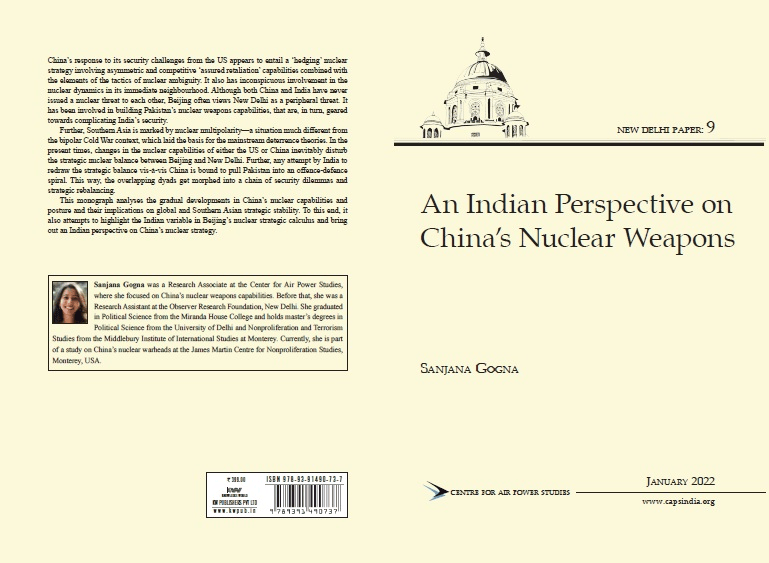
An Indian Perspective on China’s Nuclear Weapons (Monograph)

China’s response to its security challenges from the US appears to entail a ‘hedging’ nuclear strategy involving asymmetric and competitive ‘assured retaliation’ capabilities. These include nuclear modernization marked by the deployment of Multiple Independently Targetable Reentry Vehicles (MIRVs) and Hypersonic Glide Vehicle (HGV) to counter the US missile defense systems.

Further, while Beijing’s nuclear strategy is primarily geared towards the US, it also has inconspicuous involvement in the nuclear dynamics in its immediate neighborhood. China is involved in protracted territorial disputes with its nuclear armed neighbor India. The territorial disputes led the two states to war in 1962, and in recent times, have caused frequent border skirmishes. Although both China and India have never issued a nuclear threat to each other, Beijing often views New Delhi as a peripheral threat. China has been involved in building Pakistan’s nuclear weapons capabilities, which the latter uses to balance against India.

The existing global nuclear dynamics are marked by nuclear multipolarity—a situation much different from the bipolar Cold War context — which make nuclear deterrence increasingly complex and enmeshed. Changes in the nuclear capabilities of either the US or China inevitably disturb the strategic nuclear balance between Beijing and New Delhi. Further, any attempt by India to redraw the strategic balance vis-à-vis China is bound to pull Pakistan into an offense-defense spiral. This way, the overlapping dyads get morphed into a chain of security dilemmas and strategic rebalancing.

China’s evolving nuclear posture in the context of nuclear multipolarity presents a unique and complex set of challenges for the world’s security. This monograph attempts to analyze the gradual developments in China’s nuclear capabilities and strategy and their implications on global and Southern Asian strategic stability. Conjoined to this endeavor is an attempt to highlight the Indian variable in Beijing’s nuclear strategic calculus, and to bring out an Indian perspective on China’s nuclear strategy.

Link to the monograph: https://capssindia.org/wp-content/uploads/2022/02/New-Delhi-Paper-9.pdf

In Ukraine and Iran, the IAEA’s Grossi Is Handling Tough Crises Well

Miles Pomper and Sanjana Gogna

Sep 13, 2022

The International Atomic Energy Agency, or IAEA, the United Nation’s nuclear-focused body, was intended to be a technical agency supporting the development of peaceful uses of nuclear energy. In recent weeks, however, the IAEA has found itself in the thick of two global political crises—concerns about combat operations around Ukraine’s Zaporizhzhia nuclear power plant and efforts to limit Iran’s nuclear program to ensure it does not develop nuclear weapons.

Rafael Grossi, the agency’s director-general, has asserted himself as a powerful player in both cases. He has successfully insisted that IAEA inspectors be allowed to visit and remain at the Zaporizhzhia plant—Europe’s largest—personally crossing through battle zones to get to the facility. And he has joined the U.S. in rebuffing Iranian demands that the agency close its investigation of suspicious nuclear material found in Iran, while managing to do so without antagonizing Tehran.

Grossi’s assertive approach marks a departure from his predecessor, Yukia Amano, who was criticized for his handling of the Fukushima nuclear accident in 2011 as well as his approach to Iran’s nuclear program. For now, Grossi has managed both files with dexterity, but his ongoing success will depend on his ability to avoid alienating any of the parties involved, which will be no easy feat.

Read the rest of the article here

From Nuclear Ambiguity to Armageddon

How is China’s nuclear ambiguity raising the risk of deterrence breakdown?

Nuclear War Paintings | Fine Art America
War Print by Peter Cutler

China’s nuclear strategy is believed to be based on the concept of limited deterrence: Its leaders have publicly held the view a small number of nuclear warheads is enough to deter nuclear attack and counter nuclear blackmail. When compared to its nuclear rivals, China’s current stockpile consisting of about 320 nuclear warheads remains greatly disproportionate to that of the United States and Russia, made up of 5,800 and 6,375 warheads respectively.

On the face of it, China’s minimalist approach towards nuclear weapons may seem lesser loaded with risk when compared to the maximalist strategies adopted by the United States and Russia. However, several of its attempts to protect its small arsenal – mainly involves maintaining a degree of ambiguity with regards to its warhead count and the characteristic of deployed weapons -have, in turn, raised the risks of deterrence breakdown.

Here’s how:

From the beginning, China’s leaders have believed that some vagueness or ambiguity is necessary to increase the survivability of its nuclear assets against a decapacitating strike by an adversary. In recent times, however, the growing emphasis in the United States to develop the Conventional Prompt Global Strike (CPGS) system along with the presence of its Ballistic Missile Defence (BMD) systems poses a challenge to the survivability as well as the credibility of China’s nuclear weapons.

The CPGS capability, which can include long-range ballistic missiles or boost-glide systems and scramjet-powered hypersonic cruise missiles, allows the United States to attack high-value targets or fleeting targets at the start of or during a conflict; the BMD, on the other hand, consisting of its National Missile Defense (NMD) and advanced Theatre Missile Defense (TMD) in East Asia, allows the United States to intercept an incoming adversary missile. Lora Salmaan, an expert on China’s nuclear weapons programs, notes that “the Chinese analysts view CPGS as part of a larger US effort to achieve ‘absolute security’, with BMD as the shield and CPGS as the sword – such that Washington is able to act pre-emptively”.

China has responded to these challenges by further complicating its nuclear ambiguity through ‘entangling‘ or mixing its conventional weapons technologies with its nuclear weapons and its associated command and control systems. Nuclear entanglement is often designed to confound an adversary that can potentially attempt a pre-emptive strike. By deliberately mixing the two capabilities, states attempt to create uncertainties regarding the adversary’s intended target, and thereby raise the risk of nuclear escalation. Nuclear entanglement is, therefore, used for an added deterrence against an adversary.

China has entangled its nuclear weapons through the deployment of dual-use weapons as well as the commingling of both the nuclear and conventional missile forces within the People’s Liberation Army Rocket Force (PLARF). Its DF-26 Intermediate-Range Ballistic Missile (IRBM), DF-21 Medium-Range Ballistic Missile (MRBM), along with possibly the DF-17 Hypersonic Glide Vehicle (HGV) can carry both conventional and nuclear payloads, and therefore, can cause warhead ambiguity.

Nuclear entanglement by dual-use weapons, however, can be quite risky; during the ‘fog of war’, any mischaracterisation of a nonnuclear weapon as a nuclear one could potentially lead to nuclear escalation. For instance, Hans M. Kristensen notes, an adversary might target a DF-26 battalion, perceiving it to be a conventional one. However, Chinese decision-makers may conclude this to be a counterforce nuclear attack in case any of those DF-26 launchers were carrying out a nuclear role, and thus escalate accordingly. China’s hypersonic missiles also carry similar risks; They follow an unpredictable trajectory and travel at speeds exceeding Mach 5 (6,100 km an hour), and therefore, can cause destination and warhead ambiguity. An adversary may reason an incoming hypersonic missile to be nuclear and may immediately issue a retaliatory strike under ‘use-or-lose’ pressures.

The comingling of China’s nuclear and conventional missiles forces also comes with another set of risks which have caused concerns among its adversaries. The recent Annual Report to Congress: Military and Security Developments Involving the People’s Republic of China 2019, for instance, remarked that the commingling could “complicate deterrence and escalation management during a conflict”. It warned that “a potential adversary attack against Chinese conventional missile force-associated Command and Control (C2) centres could inadvertently degrade Chinese nuclear C2 and generate nuclear use-or-lose pressures among China’s leadership”.

Of late, China has also evinced interest in developing space-based early-warning reconnaissance capabilities in order to detect a boost-glide weapon shortly after launch. It may further pave the way for ‘launch on warning’ or ‘launch under attack’ nuclear posture. Although China, at present, keeps its nuclear weapons de-mated and dispersed – it is, nevertheless, financially and technologically capable of developing and deploying such systems. Any move in that direction, especially given China’s ambiguous nuclear weapons program, could heighten the potential for a false alarm.

Both the US and Russia use early warning systems and have had a history of false alarms that brought the two countries to a nuclear close call on multiple occasions. However, unlike the US and Russia, which were involved in several bilateral nuclear arms control arrangements when those incidences occurred, China has not adopted any such confidence-building measures with its nuclear adversaries. The lack of confidence building mechanisms with other countries can cause building up of tensions and mistrust, which can lead China into similar situations of false warnings.

Last but not least, these developments are taking place against a global backdrop that is fast becoming unconducive to strategic stability; The United States withdrawal from the Intermediate-Range Nuclear Forces (INF) Treaty – a bilateral agreement between Washington DC and Moscow to ban the use of missiles with ranges between 500 and 5,500 kilometres – in 2019 marked a low point in the crumbling of the arms control architecture. It has seemed to raise China’s threat perceptions as Further, the introduction of various technologies, such as hypersonic missiles as well as multiple independently re-entry Vehicles (MIRV), has intensified the offence-defence spiral not just between the United States and China, but also with regards to their other nuclear adversaries, namely Russia and India respectively. For instance, India tested its Hypersonic Technology Demonstration Vehicle (HSTDV) earlier in September this year. The prospects of a multilateral arms control architecture also look increasingly bleak as China seems to be unwilling to enter the New Strategic Arms Reduction Treaty (New START) with the United States and Russia until it attains parity with them in terms of the size of the nuclear arsenal.

While China’s policy of limited deterrence can offer some stability amidst its aggressive nuclear modernisations, its strategy of nuclear ambiguity negates its stabilising effect. It also seems unlikely that China would be willing to be involved in risk-mitigation measures with its nuclear adversaries in order to reduce the chances of a nuclear breakdown.

Can the CTBT deliver on its promises?

Nuclear War Painting - Apocalypse 3050 by William Douglas
Apocalypse 3050 by William Douglas

The U.S. Department of State report titled ‘2020 Adherence to and Compliance with Arms Control, Non-proliferation, and Disarmament Agreements and Commitments’ released on 15 April 2020 raised concerns regarding China’s adherence to the ‘zero yield’ standard. It hinted towards possible testing by China due to high level of activities at its Lop Nur nuclear weapons test site. The activities include extensive excavations and the use of explosive containment chambers. The report also took note of the frequent blocking of the flow of data from China’s International Monitoring System (IMS) stations to the International Data Center operated by the Preparatory Commission for the Comprehensive Nuclear Test-Ban Treaty Organization.

The ‘zero yield’ is a tricky concept; it relates to Article 1 of the Comprehensive Nuclear-Test-Ban Treaty (CTBT) that states that “Each State Party undertakes not to carry out any nuclear weapon test explosion or any other nuclear explosion, and to prohibit and prevent any such nuclear explosion at any place under its jurisdiction or control”. Curiously enough, the ‘zero yield’ is not mentioned in the official CTBT text; moreover, neither the U.S., nor China is party to the treaty. Rather, the concept of the ‘zero yield’ has been advocated by the U.S. Department of State, which assumes that all the states party to the treaty share a common understanding of the concept.

The official American report led to much media reporting and speculation. One piece in Wall Street Journal titled ‘Possible Chinese Nuclear Testing Stirs U.S. Concern’ suggested that China might be secretly conducting nuclear tests with very low explosive power. However, it noted that “the coming report does not present proof that China is violating its promise to uphold the agreement”. American nuclear strategy expert Jeffery Lewis also noted that the evidence was thin to support claims of nuclear testing, but suggested that available evidence was consistent with low-yield tests or with sub-critical tests which are permitted by the CTBT. The Guardian quoted a senior U.S. official asstating that “the concerns about China’s testing activities buttressed President Donald Trump’s case for getting China to join the U.S. and Russia in talks on an arms control accord to replace the 2010 New START (Strategic Arms Reduction Treaty)between Washington and Moscow that expires in February next year”.

The Global Times, the Chinese Communist Party’s mouthpiece, dismissed the claims about nuclear testing. It quoted a Chinese expert to suggest that the accusation is a “U.S. attempt to push China into a Western countries-led nuclear treaty while also diverting domestic pressures caused by the novel coronavirus”. The Chinese Foreign Ministry spokesperson argued that “By asking China to join the arrangement and seeing China refuse to do so, the U.S. is also hoping to gain a public opinion advantage for itself to further make tactical, low-yield nuclear weapons, which the U.S. has already developed and deployed on its missiles”.

Soon thereafter, on 8 May 2020, the Chief Editor of the Global Times, Hu Xijin made a case that “China needs to expand the number of its nuclear warheads to 1,000 in a relatively short time”. He asserted “peaceful coexistence between the two countries (China and the U.S.) is not a thing that can be begged for; it’s shaped by strategic tools. This is particularly true as we are facing an increasingly irrational U.S., which only believes in strength”.

Weeks later, on 30 May 2020, the Washington Post broke the news that the U.S. could resume live nuclear tests within ‘months’. If the tests were to happen, they would violate the U.S. moratorium on any kind of explosive nuclear testing it self-imposed in 1992. The article cited a senior administration official suggesting that the demonstrations of tests would be a bargaining counter to pressure Russia and China to enter into a trilateral arms control deal. The U.S. has been keen to include China into the purview of the New START treaty, which it entered into with Russia in 2011, and is awaiting renewal in 2021. If the said rationale behind the resumption of the testing by the U.S. is true, it would certainly be a dangerous tactic to initiate arms control talks with its adversaries. China has been reluctant to enter into any arms control agreement, and more particularly the New START treaty with the U.S., for the reason that its quantity and quality of nuclear weapons is much lower than that of the U.S..

This chain of events is a manifestation of the inadequacies of the existing arms control arrangements, and more particularly the CTBT. The CTBT was opened for signature in 1996, and it seeks to ban all nuclear explosions on Earth whether for military or peaceful purposes. The fundamental issue with the CTBT is its non-enforcement. As per the Article XIV of the treaty, 44 states identified as ‘nuclear-capable’ must sign and ratify the treaty for it to enter into force. Of these 44 states, five states, namely China, Egypt, Iran, Israel, and the United States have signed but not ratified the CTBT; whereas, North Korea, India, and Pakistan have neither signed nor ratified the treaty. As the treaty has not yet entered into force, there are no mechanisms for on-site inspections of the suspected sites (such as the Lop Nor testing facility in the case discussed above). Further, its lack of enforcement engenders suspicion and mistrust, which can thereby generate security dilemmas. It is evident in Hu’s statement mentioned earlier.

Another curious case of the CTBT is its ‘zero yield’ standard, which triggered the speculation mentioned above. A lack of clear understanding of the ‘zero-yield’ has caused several states to draw their own interpretations. For instance, the general understanding, as assumed by the U.S., is that ‘supercritical hydronuclear tests (which produce a self-sustaining fission chain reaction) are banned, but subcritical hydrodynamic experiments, which do not produce a self-sustaining fission chain reaction, are permitted’. These self-serving interpretations further generate mistrust between the nuclear weapons states. To illustrate, the U.S. as per its understanding of the zero yield’ has conducted a subcritical nuclear test at its Nevada Test Site, but has called out on China and Russia for not conforming to those standards.

The global reality is that several nuclear states are at different stages of the development of their nuclear weapons and have varied strategic ambitions and concerns. The U.S. and Russia, for instance, have conducted 1032 and 727 nuclear weapons tests, respectively. China, on the other hand, has conducted 47 tests, and India and Pakistan have conducted 5 and 6 tests respectively. The U.S. has been stalling the ratification for two prime concerns relating to – first, its ability to maintain a credible stockpile without testing; second, its ablility to detect violation of the CTBT. China, on the other hand, has made its ratification of the treaty conditional on the U.S. ratification. Among the other non-signatories, India, despite its support to the CTBT, has made its signing conditional on several reciprocal activities from the nuclear weapons states which include halting future tests under the guise of safety purposes as well as all horizontal and vertical proliferation. Much like China, Pakistan with its security linked to India’s nuclear weapons programme, is not willing to enter the treaty unless India ratifies it first.

Given the differing strategic needs and concerns of the nuclear weapons states, a blanket ban on nuclear weapons testing is unlikely to translate into reality in the present circumstances. The collapse of the Intermediate-Range Nuclear Forces (INF) Treaty and the uncertainty regarding the New START already indicate a disconcerting trend in the arms control arrangement. Additionally, except North Korea, all nuclear weapons states have self-imposed a moratorium on their nuclear testing, based on their understanding of zero yield; However, if the U.S. and China were to conduct nuclear tests, it would set a bad precedent, as other states would find it easier to conduct and justify their testing. In the face of all these challenges, the CTBT, in its current form might not be able to deliver on its promise

China’s Changing Nuclear Posture (and its Implications for India)

Nuclear War Painting - Call Of Duties Freedom Isn't Free by Ian Young
Call Of Duties Freedom Isn’t Free by Ian Young

China’s most recent White Paper on National Defence (DWP) released in July 2019 titled ‘China’s National Defense in the New Era’ offers some insights into China’s strategic plans and its current nuclear thinking. It remarks that the ‘current global order is marked by rising international strategic competition’, adding that ‘the adjustments in the national security and defence strategies of the United States have undermined global strategic stability’. It further adds that the intensified competition among major countries has pushed for additional capabilities in nuclear, outer space, cyber and missile defence, and in view of this, it asserts that China’s nuclear capabilities remain a strategic cornerstone in safeguarding its national sovereignty and security.

The DWP reiterates China’s nuclear policy in the following statement: 

“China is always committed to a nuclear policy of no first use of nuclear weapons at any time and under any circumstances, and not using or threatening to use nuclear weapons against non-nuclear weapon states or nuclear-weapon free zones unconditionally. China advocates the ultimate complete prohibition and thorough destruction of nuclear weapons. China does not engage in any nuclear arms race with any other country and keeps its nuclear capabilities at the minimum level required for national security. China pursues a nuclear strategy of self defense, the goal of which is to maintain national strategic security by deterring other countries from using or threatening to use nuclear weapons against China.”

The above statements do not indicate any changes to the basic nuclear policy and principles that China announced when it first tested its nuclear weapons in 1964; However, the display of new nuclear arsenal 70th-anniversary parade that took place on October 1st 2019 in conjunction with the changes in the management of the nuclear weapons by the PLA might signal looming postural changes.

During the 2019 parade, China showcased its ( now also the world’s) longest-range intercontinental ballistic missile (ICBM) Dong Feng 41 (DF-4I) that offers an operational range exceeding 14,000 kilometres, enabling China to reach the United States within the time frame of thirty minutes. It effectively surpasses the range of the latter’s longest ICBM LGM-30 Minuteman that has a reported range of 13,000 kilometres. The British think tank, the International Institute for Strategic Studies (IISS) has reported that the DF-41 is reportedly capable of carrying multiple independently re-entry vehicles (MIRV) or jammers and penetration aids. The Chinese Communist Party-run Global Times claims that DF-41 has the capacity to carry about ten independently targetable nuclear warheads. Notwithstanding, some experts suggest that the purpose of the MIRVs is to ensure penetration of the US ballistic missile defence system rather than maximising its warhead capacity.

At the parade, China also debuted the submarine-launched ballistic missile (SLBM) Ju Lang-2 (JL-2) that forms a standard weapon component for China’s Jin Class nuclear armed submarines. It has been long suspected that China has had been conducting tests of the JL-2 from trial submarines since 2002 and the weapon became operational in 2014. The JL-2 has a range of 7,200 kilometres, and is therefore, designed to respond to threats emanating in China’s neighbourhood, especially as the United States continues to assert its military presence in the region. Further, China showcased the Dong Feng 17 (DF-17), which is a type of ballistic missile capable of carrying a hypersonic glide vehicle (HGV) that can penetrate the missile defence systems deployed by the United States and its allies.

These developments signal a move towards a more assertive and transparent nuclear posturing. The debut of DF-41 and JL-2 demonstrate China’s efforts to offset the United States’ strategic superiority, at least in the region that matters the most to China, as well as its presence in China’s neighbourhood. 

Notwithstanding these developments, China is unlikely to deviate from its stated nuclear policies or principles of ‘minimum deterrence’, wherein it maintains limited nuclear arsenals. China has repeatedly asserted that it has no intention to attain nuclear parity with the United States as far as the number of nuclear warheads is concerned. According to the latest Stockholm International Peace Research Institute (SIPRI) report, China possesses about 280 nuclear warheads as compared to 6,450 held by the United States.

Going forward, China is expected to modernise its nuclear force in a lean and effective manner. According to a report by RAND Corporation, China’s nuclear modernisation is not constrained by the limits of defence spending. Instead, it has reportedly invested less on its nuclear force build-up than what its resources allow. Modernisation of China’s nuclear capabilities is likely to be in the fields of missile defence systems or the incorporation of new penetration capabilities such as HGVs, decoys, or MIRVed systems with an eye to maintain survivable retaliatory capabilities. 

It is worth paying attention to the workings within the People’s Liberation Army Rocket Force (PLARF) that has been tasked with managing China’s conventional and strategic missiles and enhancing China’s nuclear deterrence and counterstrike capacities. As of 2016, half of the PLARF’s brigades have been armed with conventional missiles even as PLARF continues to be involved in nuclear missions. The co-management of conventional and strategic missiles and the lack of firewall between the conventional and nuclear warfare poses risk of inadvertent nuclear escalation. 

India and China continue to be involved in territorial disputes. Although the two are unlikely to engage in a nuclear exchange given their ‘No First Use’ doctrines, the build-up of China’s nuclear capabilities in the absence of a strategic dialogue on stability issues poses the risk of sucking India into an offence – defence spiral. For instance, developments in China’s nuclear capabilities could put pressure on India to to maintain technological parity with China. India needs to carry out its own security audit and choose its own nuclear capability prudently. Meanwhile, proliferation of technologies from China to Pakistan will have to be under a close watch too.

 The article first appeared on the Center for Air Power Studies website.